
'/%3e%3cdefs%3e%3clinearGradient%20id='prefix__paint0_linear_4737_37157'%20x1='3.018'%20y1='23.6'%20x2='44.925'%20y2='24.977'%20gradientUnits='userSpaceOnUse'%3e%3cstop%20stop-color='%231CB7FF'/%3e%3cstop%20offset='.502'%20stop-color='%232FF58B'/%3e%3c/linearGradient%3e%3c/defs%3e%3c/svg%3e)

It’s easy to see why Man United feel liberated – but here comes the hard part
Jan 19 2026 07:16 · Par onefootball.com · 31 Lectures


Pep Guardiola ’s 55th birthday fell on Sunday. It may not be his happiest. The present could come in the form of Marc Guehi, when he signs. But if Guardiola’s mood may be altered by perhaps the most comprehensive derby defeat he has suffered in almost a decade in Manchester, he might have been facing another manager to celebrate a birthday in January. A year earlier, Ruben Amorim remarked that, after two months at Manchester United , he felt 50, not 40.
Two weeks after leaving, maybe Amorim is fresher-faced and youthful again. But he did win his first Manchester derby in charge. So, 13 months later, did Michael Carrick . Yet a bad day for Guardiola could also be seen as a similarly damaging one for Amorim.
Carrick’s superlative start was in part an indictment of the man who was supposed to be United’s answer to Guardiola. Much that has happened in the last fortnight is that the previous interim Darren Fletcher started by switching to a back four. He conjured three goals in two games from Benjamin Sesko, after two in 17 for Amorim. Fletcher, though, did not win.
Carrick did. With a back four, with flying wingers, with Bruno Fernandes as a No 10, with Kobbie Mainoo in the midfield. His choices showed a decisiveness, and the way his gameplan was executed reflected well on a coaching staff drawn from United, England and Middlesbrough. Yet the flippant explanation may be simply that Carrick did the opposite of everything Amorim did. There was a fast start, a second half that was won, a clean sheet: this was rarely the Amorim way .
But the same 11 players could have been configured in Amorim’s beloved 3-4-3. And yet, of the 10 outfield players Carrick selected, only one had really occupied the same position under Amorim this season: Casemiro as one of two central midfielders. Mainoo, after all, had not been granted a Premier League start, Lisandro Martinez and Harry Maguire had tended to play in back threes, while there were no full-backs or wingers.
It was hard to escape the sense United had been held back by dogmatic decision-making. Mainoo is an incomplete midfielder, and not a defensive one, but he is also a far better one than Amorim ever seemed to acknowledge. But for regime change, Mainoo may have been eyeing a loan move this month. Amorim deemed him Fernandes’ understudy for the No 8 position: but the captain has been the most consistently creative player in the division. His through ball for Bryan Mbeumo’s goal constituted an argument for using him as a No 10.
There is a temptation to see much of the match as a reaction to Amorim’s departure. United looked liberated. There was a bond between players and crowd which, while the match-going public never turned on Amorim, showed the public felt happier. “One important thing that Michael Carrick said was ‘use the energy of the people’,” said Martinez.
A reason why United tend have an excellent record in the short-term reigns of their former players turned temporary managers is that they can seem glad to see the supposed permanent choice gone. And if that may reflect badly on the players who can deliver more for an interim, whatever their official title, than the man who was supposed to be in charge for years, it can sometimes seem a return to reason.
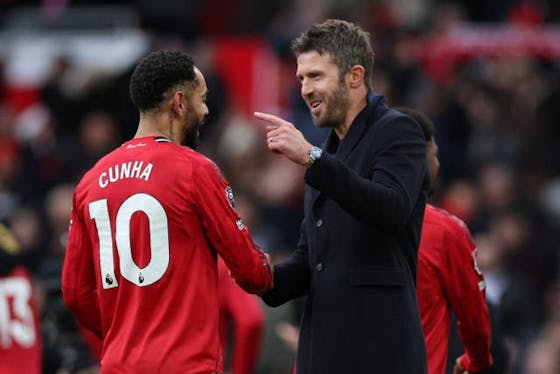
open image in gallery
Carrick inspired a much-improved display from United on derby day (Reuters)
But if United are in a process of deAmorimisation , it comes with complications. He inherited a squad unsuited to 3-4-3 and remodelled it. Now it is imbalanced to play 4-2-3-1. Instead of a model of two players for every position, there is a lopsided look. There are three whose best position is No 10, in Fernandes, Cunha and Mason Mount, but only three who prefer to be in the centre of midfield, in Casemiro , Mainoo and Manuel Ugarte. United always intended to target midfielders this summer. They look still shorter of them now.
But after Amorim alienated and exiled Marcus Rashford and Alejandro Garnacho, there is no real specialist left winger in this squad; or if Patrick Dorgu counts, after his terrific derby display, then there is a lone out-and-out left-back. All of which could mean United lack players for key roles later in the season.
Meanwhile, there was always the problem that Amad Diallo and Bryan Mbeumo could both covet the same spot, when each is clearly among United’s finest players. Amorim’s answer was often to play them as right wing-back and No 10; Carrick used them as winger and striker.
Part of Amorim’s legacy was to add to United’s rebuilding job in the summer; as became clear of late, director of football Jason Wilcox’s preference was for a back four. That attempt to deAmorimise even while he was still in a job may have led to his departure.
Carrick’s Premier League record in charge of United, spread across two spells, is wins over Arsenal and City , with a draw at Chelsea. It is Arsenal next, so he must hope to extend his run as the scourge of the elite. But Amorim’s greater failings came against the mid-table and bottom-half teams. United’s February and March fixture list is full of such sides. So the test, once again, will be to prove the opposite of Amorim then.