
'/%3e%3cdefs%3e%3clinearGradient%20id='prefix__paint0_linear_4737_37157'%20x1='3.018'%20y1='23.6'%20x2='44.925'%20y2='24.977'%20gradientUnits='userSpaceOnUse'%3e%3cstop%20stop-color='%231CB7FF'/%3e%3cstop%20offset='.502'%20stop-color='%232FF58B'/%3e%3c/linearGradient%3e%3c/defs%3e%3c/svg%3e)

Arsenal's biggest weakness has been found out - this is where it's costing them, why they need to fix it fast and how Mikel Arteta can do just that
Dec 17 2025 11:16 · By Isaan Khan · 5 Reads


Arsenal 's nail-biting win over Wolves on Saturday saw the recurrence of a worrying trend.
The Gunners have conceded game-changing late goals against Sunderland and Aston Villa in recent weeks, and it looked like they had let their guard down again when Tolu Arokodare scored on the brink of stoppage time at the Emirates Stadium.
Luckily for Mikel Arteta , there was still enough seconds on the clock for his side to go up the other end and score a late winner. Crisis averted, this time.
But after enduring the emotion of having seen his side come so close to squandering points on consecutive weekends in the Premier League , following the loss at Villa, Arteta was brutally honest post-match.
‘We had a period of two or three minutes (where we were) deep, totally passive, with horrible defensive habits. That is nowhere near the level required against a team that hasn't had a single shot,’ he raged.
‘The first time they had the opportunity to do it, they scored the goal, and this is the Premier League.’
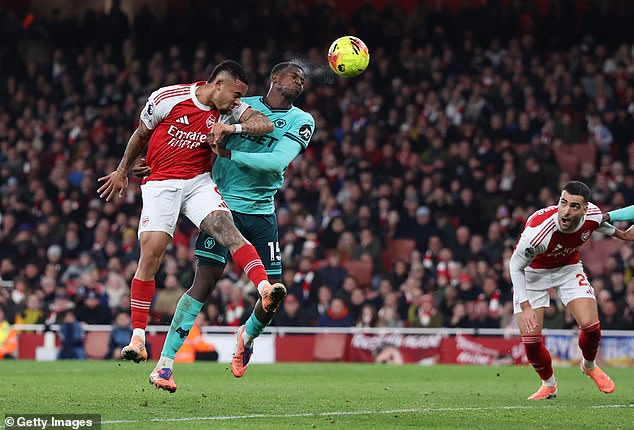
It looked as if Arsenal had conceded a late game-changing goal for the third time in six Premier League games when Wolves' Tolu Arokodare equalised in the 90th minute on Saturday
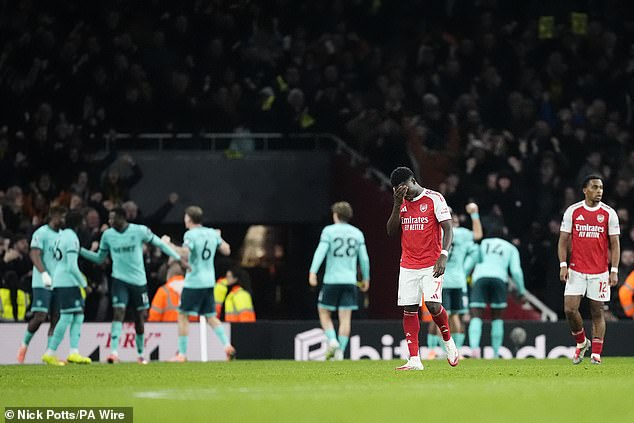
Luckily for the Gunners they had enough time to go up the other end and find a winner, through a Yerson Mosquera own goal, but it won't dispel the anxieties about this worrying trend
Boss Mikel Arteta was furious after the narrow win over the League's bottom club, lambasting his side's 'horrible defensive habits'
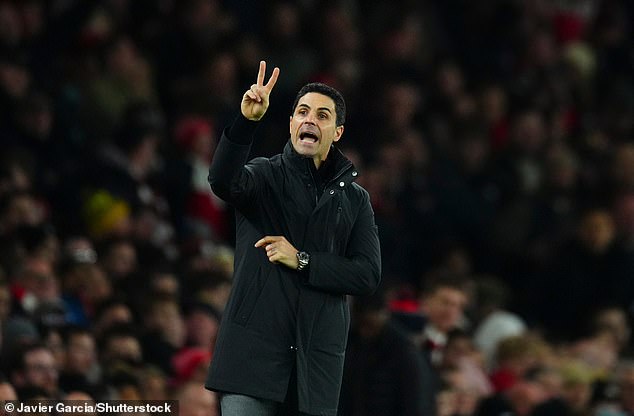
The Spaniard’s fury is understandable. Switching off and conceding late goals is emerging as Arsenal's biggest weakness this campaign.
Sunderland, Villa and Wolves are very different teams, who found themselves in different game scenarios, from desperately trying to salvage a draw to frantically searching for a winner, but all managed the same thing: to score a late goal.
The biggest crime was that Arsenal dropped deeper and deeper into their half in the clsoing stages of all three games. No longer defending on the edge of their box, their defensive line became level with the penalty spot allowing the opposition to ping dangerous balls into the area that led to goals. With no pressure on the crosser it is asking for trouble.
Overall, the team shape was increasingly camped in their own half, allowing opponents to have possession in attacking areas and target one thing above all: balls into the box.
Against Sunderland, Arsenal allowed repeated deliveries from wide areas late on, often uncontested. Across the match, Regis Le Bris’ team made seven open-play crosses; five of those were after 80 minutes. That tells a story in itself.
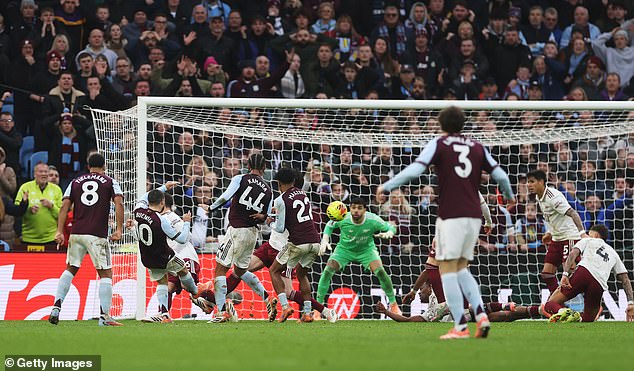
And at Villa Park, full backs Lucas Digne and Matty Cash were afforded the time to deliver balls in from deep. The havoc created by one such cross led to Emi Buendia's late winner.
Arsenal allowed Aston Villa to build late pressure in their loss to Unai Emery's men, affording the full backs far too much time to whip in crosses in the build-up to Emi Buendia's winner
Wolves, meanwhile, went direct like Sunderland with diagonal balls into the box. They made eight open-play crosses across the match; six of those were after 80 minutes.
The Gunners did not lose control because they were being played through. They lost it because they were allowing deliveries into the area. For Arokodare's goal, Mateus Mane was given time to clip the cross into the area with Bukayo Saka and Martin Odegaard slow to close him down. With the Gunners so deep, Arokodare only had to get a touch for the ball to fly in. Had Arsenal been on the front foot and on the edge of their box Arokodare would not have been able to score so easily.
With teams defending deep in their box, second balls become more troublesome too (see Buendia's goal) so even if the first cross is not deflected in, danger lurks.
Much of Arsenal's vulnerability stems from the average positions their backline and midfield have been taking up later in matches.
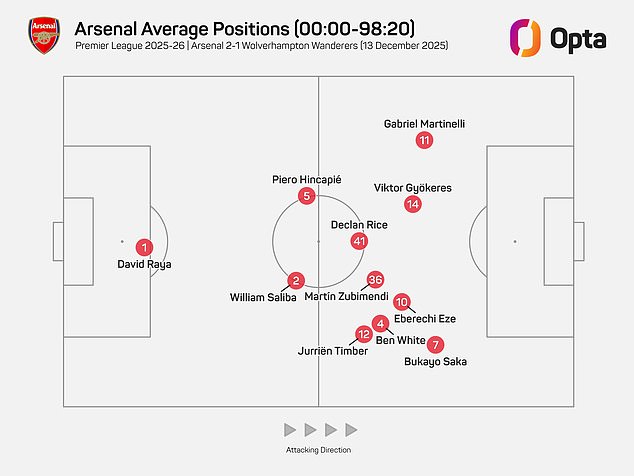
Across the duration of the game against Wolves, defenders Piero Hincapie and Jurrien Timber's average positions were on the halfway line and just inside the opposition half respectively.
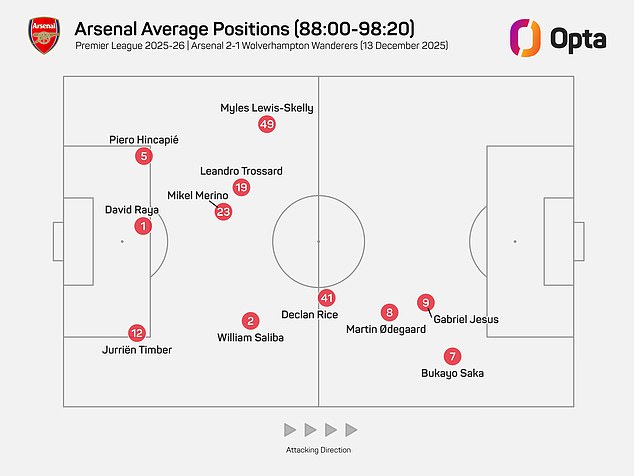
But in the final 10 minutes, they were both stuck inside their own box, a marked positional change.
Defenders Piero Hincapie and Jurrien Timber pushed up high for most of the match against Wolves, with their average position on the halfway line and just inside the opposition half respectively
But in the last 10 minutes of the match, both players were forced inside their own box, illustrating the alarming extent to which Arsenal dropped deep in the latter stages
For the final 10 minutes in the 2-2 draw with Sunderland, Hincapie, Timber, Martin Zubimendi and Odegaard were all camped on the edge of the box.
With the midfielders dropping back so deep, the opposition had free rein to ping crosses in, and take advantages of ricochets and loose balls. It is also harder for Arsenal to play out from the back with everyone so deep in their own half.
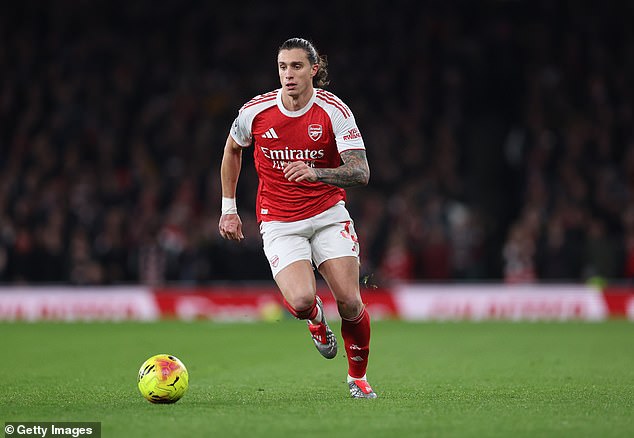
There are solutions. The most obvious is to resist the urge to drop deep. Have confidence on the ball, keep the full back inverted into the midfield to give passing options to team-mates. Resist that natural inclination to protect what you have. Make the opponent defend instead of allowing them to solely focus on attack.
By keeping a full back like Riccardo Calafiori high up in the pitch even in the latter stages, Arsenal can relieve pressure and force the opposition to defend as well as attack
The second is to protect the wide areas earlier and block the cross at source. This could mean bringing on fresher wide players to track back and engage with the opposition’s wingers.
And then finally, be more proactive than reactive. Arsenal’s box defending late on can often look reactive, rather than specific players assigned to roles such as attacking first balls, for example.
The Gunners are still an elite defensive side over 90 minutes. But matches are not decided over 90 minutes, and defining moments often happen in the last 10.
Arteta has built a team capable of controlling games. The next step is learning how to close them out.